The legend: Murugan’s victory over Soorapadman
The central story of Tiruchendur is told in the Tamil Kanda Puranam of Kachiyappa Sivachariyar, itself based on the Sanskrit Skanda Purana. The asura Soorapadman and his brothers Simhamukhan and Tharakasuran had won from Lord Shiva a boon that made them almost invincible: only a son of Shiva could defeat them. Grown arrogant, they ruled the three worlds from Soorapadman’s island city of Veeramahendrapuri in the sea and imprisoned the devas.
In answer to the devas’ prayers, Murugan was born from sparks of Shiva’s third eye. Raised by the six Karthigai maidens, he was given the Vel, the divine spear, by his mother Parvati and led an army against the asuras. Before the final battle he camped on the shore at Tiruchendur and sent his lieutenant Veerabahu across the sea as a messenger, asking Soorapadman to free the devas. Soorapadman refused.
The war that followed lasted six days. On the last day Soorapadman took the form of a vast mango tree spreading across the sea. Murugan hurled the Vel and split the tree in two: one half became a peacock, which Murugan took as his mount, and the other a rooster, which he placed on his banner. Even the defeated demon was given a place in Murugan’s service — a theme of grace that devotees still dwell on today.
After the victory Murugan worshipped Shiva at Tiruchendur. This is why the presiding deity here is portrayed in worship, and why the six days of that war are observed every year as Kanda Sashti, ending with Soorasamharam enacted on this very beach.
Tiruchendur in ancient Tamil literature
Tiruchendur is one of the oldest continuously worshipped sacred sites in the Tamil country. The official temple website describes the temple as being between 2,000 and 3,000 years old, and notes that it is mentioned in Sangam literature and in the epic Silappathikaram.
- Thirumurugatrupadai by the poet Nakkeerar — the first poem of the Sangam anthology Pathuppattu and the first of the “guide poems” that direct devotees to Murugan’s six abodes — praises the Lord at Thiruchiralaivai, the old name of Tiruchendur.
- Silappathikaram, the great Tamil epic, refers to Murugan’s seashore shrine at Seeralaivai.
- The Shaivite saint Appar refers to the town in his Thevaram hymns, making Tiruchendur one of the vaippu sthalams of the Thevaram tradition.
- The fifteenth-century poet-saint Arunagirinathar sang dozens of his Thiruppugazh hymns on Tiruchendur, among the largest number he dedicated to any single temple.
- Tradition holds that Adi Shankaracharya composed the Sanskrit hymn Subramanya Bhujangam at Tiruchendur, where he was cured of illness. The temple’s famous panneer ilai vibhuti — sacred ash wrapped in panneer leaves — is associated with this story.
- Kumaraguruparar, born at nearby Srivaikuntam and said to have been mute as a child, is believed to have gained speech through Senthil Andavar’s grace and composed the Kandar Kalivenba in his honour.
Royal patronage through the centuries
Tiruchendur lies in the heart of the old Pandya country, and the Pandya kings were the temple’s earliest known royal patrons. Inscriptions in the temple, including records attributed to the ninth-century Pandya king Varaguna, document endowments of land, gold and lamps for worship. Over the following centuries the Cholas, the later Pandyas, the Vijayanagara rulers and the Nayaks of Madurai each added to the temple, its mandapams and its festival endowments.
The temple’s grand festivals, many of its halls and its system of daily kala poojas reflect these layers of patronage. Local chieftains, merchant communities and ordinary devotees also contributed, a tradition that continues in the offerings and donations made today.
The Dutch occupation, 1646 to 1648
The most extraordinary episode in the temple’s recorded history came in the seventeenth century. During the struggle between the Dutch East India Company and the Portuguese for control of the pearl-fishing coast, Dutch forces occupied the Tiruchendur temple from about 1646 to 1648 and used its strong stone walls as a fort.
Local people resisted, and the ruler of Madurai, Thirumalai Nayak, demanded that the Dutch leave. When they withdrew, they carried away the temple’s festival idols — the painted panels inside the temple name the images of Shanmukhar and Nataraja. According to tradition, as their ship sailed, a violent storm arose; the frightened sailors threw the idols into the sea, and the storm calmed.
A devoted official named Vadamalaiyappa Pillai is credited with recovering the idols. Tradition holds that the Lord appeared to him in a dream and told him to look where a lemon floated on the water and a kite circled overhead. The idols were found at that spot and brought back to the temple in 1653, where Shanmukhar is still worshipped today.
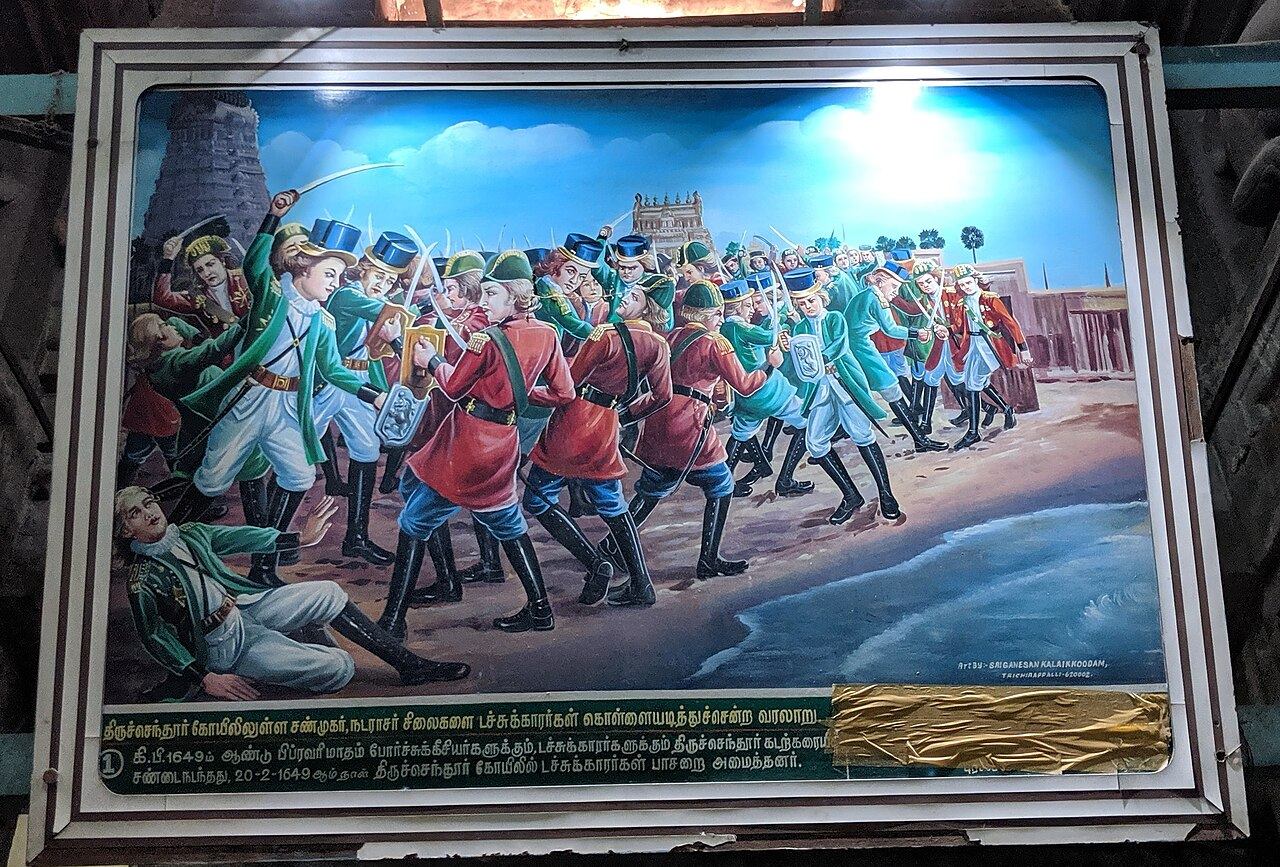
The story is told in a series of painted panels inside the temple, and it remains one of the best-loved accounts of Senthil Andavar’s protection of his devotees.
The Rajagopuram and the temple complex
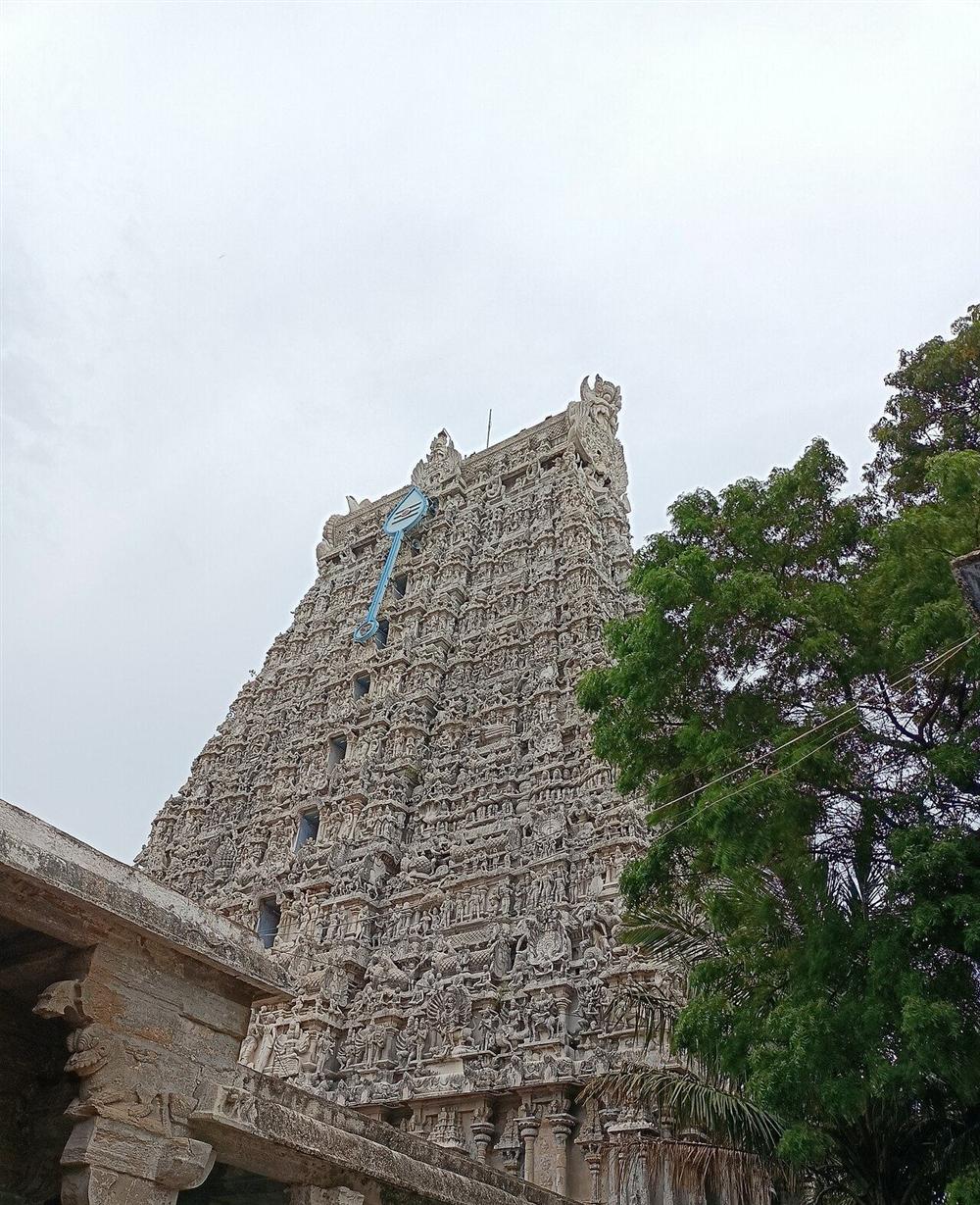
The temple’s crowning feature is its Rajagopuram, 157 feet (about 48 metres) tall with nine tiers, covered with hundreds of stucco figures from Murugan’s legends. It is visible from far out at sea and has long served as a landmark for fishermen along the coast.
According to temple history, the Rajagopuram was not raised by a king but by ascetics: the work was begun by Desikamoorthy Swamigal and carried on by Kasi Swamigal and Arumuga Swamigal, who gathered funds from devotees over many years. Unusually, the tower stands on the western side, and the everyday entrance into the temple is not through it.
Layout of the temple
The temple complex measures roughly 91 metres from north to south and 65 metres from east to west, and is enclosed by two prakarams (circumambulatory corridors) lined with carved pillars and yali figures. Key parts of the complex include:
- The sanctum, facing east towards the sea, with Senthil Andavar in the cave-like moolasthanam.
- The Shanmukhar shrine, home of the six-faced festival deity with Valli and Deivanai.
- Shanmuga Vilasa Mandapam, the grand pillared hall at the front of the temple.
- Nazhi Kinaru, a small freshwater spring-fed well about 100 metres south of the temple, used by pilgrims to rinse after the sea bath. That fresh water rises a few steps from the salt sea has long been regarded as a wonder.
- Valli Guhai, the small cave shrine of Valli on the shore.
The temple in modern times
Since the twentieth century the temple has been administered under Tamil Nadu’s Hindu Religious and Charitable Endowments laws. Under the HR&CE Department it became, in 2016, one of the first temples in the state to receive ISO certification for its management systems. Services such as annadanam (free meals), online booking and darshan queue management have been expanded to cope with the tens of thousands of devotees who visit daily, and with crowds of lakhs during Kanda Sashti.
From 2022 the temple and its surroundings underwent their largest renovation in living memory, including restoration of the Rajagopuram and new facilities for pilgrims. The work culminated in the Maha Kumbabishekam on 7 July 2025, sixteen years after the previous consecration in 2009.
Timeline
| Period | Event |
|---|---|
| Sangam era | Tiruchendur (Thiruchiralaivai) praised in Thirumurugatrupadai; mentioned in Silappathikaram. |
| 7th century CE | Appar refers to the town in his Thevaram hymns. |
| 9th century CE | Pandya royal endowments recorded in temple inscriptions. |
| 15th century | Arunagirinathar sings Thiruppugazh hymns on Tiruchendur. |
| 1646–1648 | Dutch forces occupy the temple; festival idols carried off and thrown into the sea. |
| 1653 | Idols recovered by Vadamalaiyappa Pillai and restored to the temple. |
| 19th–20th century | Nine-tier Rajagopuram raised through the efforts of successive ascetics. |
| 2009 | Maha Kumbabishekam. |
| 2016 | ISO certification of temple management. |
| 7 July 2025 | Maha Kumbabishekam after major renovation. |
Questions devotees ask
How old is Tiruchendur Murugan Temple?
The official HR&CE temple website describes the temple as between 2,000 and 3,000 years old. It is mentioned in Sangam literature such as Thirumurugatrupadai and in the epic Silappathikaram.
Who built the Tiruchendur Rajagopuram?
According to temple history, the 157-foot, nine-tier Rajagopuram was raised through the efforts of ascetics — begun by Desikamoorthy Swamigal and continued by Kasi Swamigal and Arumuga Swamigal — with funds collected from devotees.
What happened during the Dutch occupation of Tiruchendur?
Dutch forces occupied the temple from about 1646 to 1648 and used it as a fort. On leaving, they took the festival idols, which were thrown into the sea during a storm. Vadamalaiyappa Pillai recovered them in 1653.
What is the old name of Tiruchendur?
Sangam literature calls it Thiruchiralaivai, “the sacred place of the gentle waves”. It is also called Jayanthipuram, the city of victory.
Sources
We check every fact on this page against the sources below. If something has changed, please tell us.