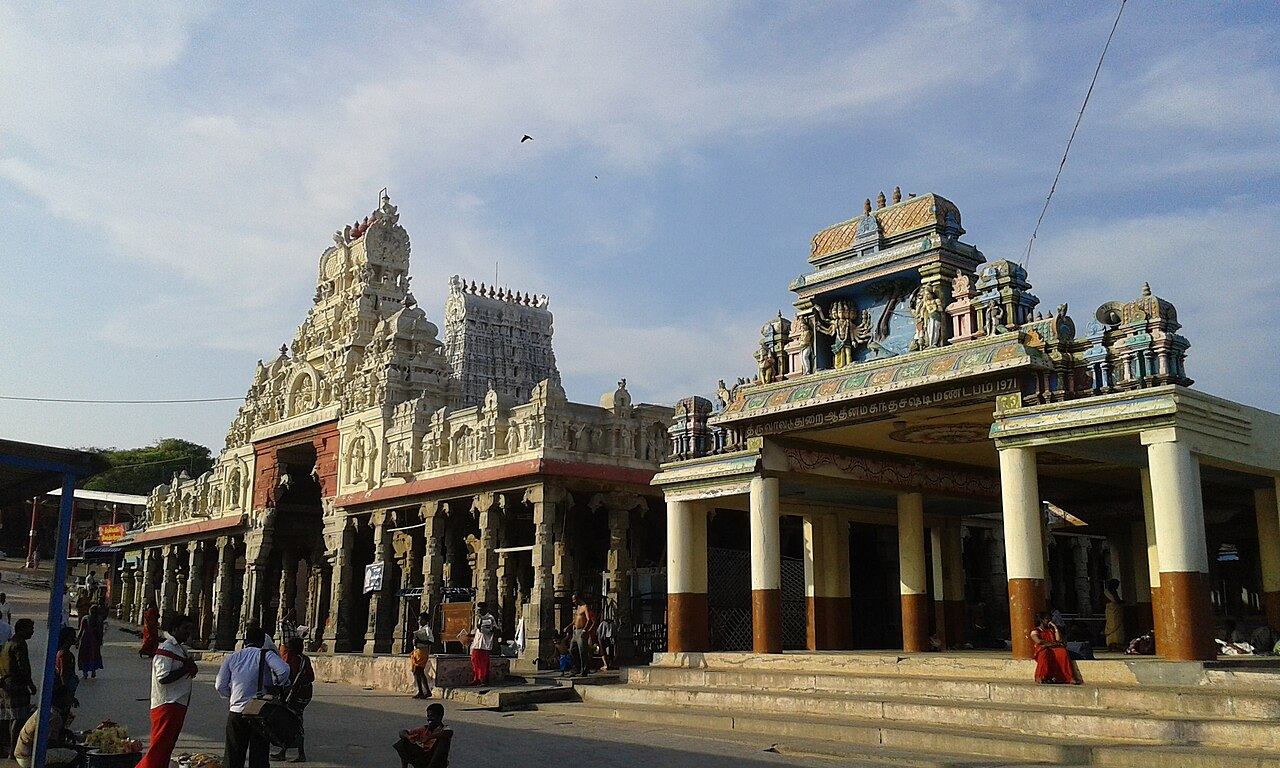
How a temple day is structured
Tamil Agamic temples worship the deity at fixed kalams (times) through the day, treating the Lord as an honoured, living presence. Tiruchendur observes a full cycle of daily kala poojas, from the waking hymns before dawn to the night-time rest.
Each main pooja follows the same pattern:
- Abishekam — the sacred bath of the deity with water, milk, curd, honey, panchamirtham, tender coconut water, sandal paste, vibhuti and rosewater, accompanied by Vedic chanting.
- Alankaram — the deity is dressed in silk and adorned with jewels, flowers and garlands. The screen is drawn during this time.
- Naivedyam — food offerings, freshly prepared in the temple kitchen, are offered.
- Deeparadhanai — lamps of different forms, ending with the camphor flame, are waved before the deity while bells ring and nadaswaram and drums play. This is the moment devotees wait for.
Temple singers (oduvars) recite Tamil hymns such as the Thevaram and Arunagirinathar’s Thiruppugazh at the poojas.
Dawn: waking the Lord
| Time | Ritual |
|---|---|
| 4:00 AM | Temple doors open |
| 5:10 AM | Suprabhatam & Thiruppalli Ezhuchi |
| 5:30 AM | Viswaroopa Darshan |
| 5:45 AM | Dhwajasthamba Namaskaram |
The day begins in darkness. The doors open at 4:00 AM, and the Thiruppalli Ezhuchi (awakening) hymns are sung to wake the Lord. At Viswaroopa Darshan devotees see Senthil Andavar before the day’s adornment — for many the most intimate darshan of the day. Worship is then offered at the flag mast.
Morning: sunrise abishekam and Kalasandhi
| Time | Ritual |
|---|---|
| 6:15 AM | Udaya Marthanda Abishekam |
| 7:00 AM | Udaya Marthanda Deeparadhanai |
| 8:00 AM | Kalasandhi Pooja |
Udaya Marthanda means “the rising sun”. As the sun rises from the sea directly in front of the temple, the moolavar receives his first abishekam of the day, followed by alankaram and deeparadhanai. The Kalasandhi pooja follows in the morning.

Midday: Uchikala Pooja
| Time | Ritual |
|---|---|
| 10:00 AM | Kalasha Pooja |
| 10:30 AM | Uchikala Abishekam |
| 12:00 PM | Uchikala Deeparadhanai |
Sacred water in kalasams is sanctified with mantras in the Kalasha Pooja and used for the grand Uchikala (noon) Abishekam. The midday naivedyam is the main meal offering of the day. After the noon deeparadhanai the temple remains open for darshan through the afternoon.
Evening: Sayaratchai
| Time | Ritual |
|---|---|
| 5:00 PM | Sayaratchai Pooja |
Sayaratchai (“evening protection”) is performed around sunset, with lamps lit throughout the temple. It is one of the most attended poojas, and the corridors fill with devotees and the sound of nadaswaram.
Night: Arthajama and Palliarai
| Time | Ritual |
|---|---|
| 7:15 PM | Arthajama Abishekam |
| 8:15 PM | Arthajama Pooja |
| 8:30 PM | Ekantha Seva |
| 8:45 PM | Ragasiya Deeparadhanai & Palliarai Pooja |
| 9:00 PM | Nadai Thirukkappu |
The night rituals begin with the Arthajama Abishekam and Arthajama Pooja, the last kala pooja of the day. In the quiet Ekantha Seva and the Ragasiya (secret) Deeparadhanai, the Lord is prepared for rest. At the Palliarai Pooja the deity is taken in a palanquin to the palliarai (bedchamber) with lullabies and music. The doors close at 9:00 PM.
Weekly, monthly and yearly observances
- Tuesdays (Sevvai) are sacred to Murugan and draw large crowds.
- Sashti, the sixth day of each lunar fortnight, is observed with fasting and special worship.
- Krithigai, Murugan’s birth star each month, is one of the busiest days; Aadi Krithigai and Karthigai Deepam are the most important.
- Visakam star, Murugan’s nakshatram, is celebrated each month and above all on Vaikasi Visakam.
- The great yearly festivals — Kanda Sashti, Masi and Avani festivals, Thai Poosam and Panguni Uthiram — are described in our festival calendar.
Questions devotees ask
How many poojas are performed daily at Tiruchendur?
The temple follows a full daily cycle of kala poojas, from the Thiruppalli Ezhuchi before dawn through Udaya Marthanda, Kalasandhi, Uchikala, Sayaratchai and Arthajama to the Palliarai Pooja at night.
What is Palliarai Pooja?
The last ritual of the day, when the deity is taken in procession to the palliarai (bedchamber) with music and lullabies before the temple closes at 9:00 PM.
Can devotees watch the abishekam at Tiruchendur?
Yes. Devotees in the darshan queues can witness the abishekams at the main poojas, and devotees can sponsor an abishekam through the temple’s seva counters.
Sources
We check every fact on this page against the sources below. If something has changed, please tell us.